
No matter how carefully a lab is prepared, chemistry experiments occasionally fail. Reactions stall, expected observations never appear, and suddenly the class is trying to figure out what went wrong.
Failed chemistry experiments can feel stressful and frustrating, especially when class time, materials, and prep are involved. But here’s the good news: a failed lab does not have to become a failed lesson.
In fact, some of the best scientific thinking happens when experiments don’t go according to plan.
Real scientists troubleshoot. They analyze errors. They revise procedures. They interpret unexpected results. When students learn how to do the same, they begin engaging in authentic scientific reasoning rather than simply following directions.
The key is having a plan for what comes next.

Shift the Focus from “Getting the Right Result” to Scientific Thinking
When a lab fails, it can be tempting to panic or immediately try to “fix” everything for students. However, unexpected outcomes often create the perfect opportunity for deeper analysis and discussion.
Instead of asking:
- “Why didn’t this work?”
shift the conversation toward:
- “What can we learn from this?”
- “What variables may have affected the results?”
- “What evidence do we have?”
- “How could we improve the procedure?”
This small mindset shift helps students understand that science is not about perfect experiments every time—it’s about investigation, evidence, and problem-solving.

Turn the Failed Lab into an Error Analysis Activity
One of the easiest ways to salvage a failed chemistry experiment is through error analysis.
Students can examine:
- Incorrect measurements
- Contaminated materials
- Temperature changes
- Timing issues
- Incomplete mixing
- Equipment errors
- Procedural mistakes
Rather than viewing mistakes as failures, students begin identifying how variables impact experimental outcomes.
This works especially well for math-related concepts such as stoichiometry labs, limiting reactant experiments, titrations, etc.
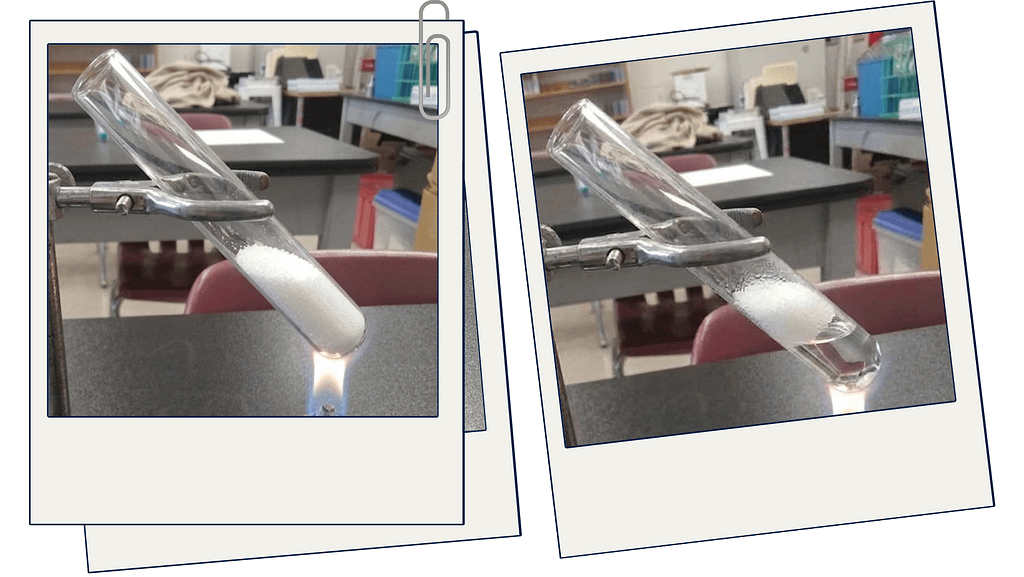
True Story: Failed Reaction Turned Lit
A combustion reaction that did not go as planned actually created more curiosity and engagement for my students. Students ultimately wanted to see the super cool end result, so they were determined to make it work.
Yes⎯this ended up taking at least two class periods, BUT the tenacity of my non-engaged, usually happy-to-sit-in-silence, students made it worth the time … And time spent learning is not a waste!
In short, we determined we were using excessive amounts of one substance (one of those necessary reasons to always test your lab ahead of time, rather than eyeball the amount in grams)
And our fancy alcohol burners were not capable of decomposing ALL of the solid in time for the reaction to take place.
Once each group learned something was off, they immediately began retracing their steps and asked for a redo.
Though I quickly saw my error, I allowed them to brainstorm what they wanted to do which led to each group changing one variable and ultimately finding the true reason behind the end result. And, yes, I owned up to my mistake which they loved LOL
The lesson here: in many cases, students gain a deeper understanding of the chemistry concept through analyzing mistakes (like this one) than they would from a perfectly successful reaction.

Ask Students: “What Should Have Happened?”
This may go without saying, but one powerful strategy is comparing expected results to actual outcomes.
CHEMTip: Keep Backup Data Ready
Backup data sets might include:
- Teacher-generated data
- Data from a previous class
- “Ideal” lab results
- Intentionally flawed data for comparison
I use pre-labs with all of my labs which include questions about expectations. Using those same questions for unexpected outcomes can help guide next steps. For example:
- Was a gas supposed to form?
- Should there have been a temperature change?
- Was a precipitate expected?
- Did the evidence support the predicted reaction?
Doing this allows students to follow through with calculations, graph results, visualize trends, and even calculate percent error … meaning the learning goals of the lab can continue even if the actual reaction doesn’t go as planned.

Use Simulations or Demo Videos
Sometimes the reaction simply cannot be salvaged in the moment.
In these situations, simulations or demonstration videos can provide students with a visual comparison to the intended experiment.
Students can:
- Compare expected and actual outcomes
- Analyze differences
- Identify procedural errors
- Discuss why the simulation worked differently
This is especially helpful when chemicals are used up, time runs out, you’re worried about safety concerns, and/or the reaction completely fails.
Having a few trusted chemistry demos or videos bookmarked ahead of time can save a stressful class period.
CHEMTip: If you use Google Classroom or similar app/space, go ahead and upload some videos prior to the lab so you can quickly pull those up.
Turn the Failed Chemistry Experiment into a Mystery Investigation
Students are naturally curious, and failed experiments can easily become engaging classroom mysteries.
Present the failed reaction as a challenge:
- What went wrong?
- Which variable caused the issue?
- Was there contamination?
- Was a reactant missing?
- Was a concentration incorrect?
This may include allowing students to redesign the experiment. Students could rewrite steps, adjust variables (pre-approved by you of course), and ultimately create a better-working lab for the next go-round.
Add an award (one free homework pass, 5 points on a test, donuts for the class, etc.) and you will have the hardest working class you’ve ever had the pleasure of teaching in Chemistry.
Normalize Mistakes in the Science Classroom
While it’s helpful to have backup activities prepared, this may not be the best moment to switch to an unrelated worksheet or review game. The purpose of a lab is to give students the opportunity to investigate, observe, and think through scientific concepts firsthand.
If a lab starts to fall apart and students are quickly redirected to a different activity, they may walk away believing that science only “works” when everything goes perfectly—or that unexpected results should simply be ignored instead of explored.
If this were the case, we’d never have antibiotics or be able to cook ramen noodles in less than 3 minutes.
My point is, failed experiments help students see science more realistically.
In many classrooms, students begin to believe that science is about following steps perfectly to arrive at one correct answer. But authentic science involves:
- Trial and error
- Unexpected outcomes
- Troubleshooting
- Revising ideas
- Learning from mistakes
When you normalize these experiences, students become more resilient, more curious, and more willing to engage in problem-solving.
And often, those are the lessons students remember most.
A Failed Chemistry Experiment Can Still Be a Successful Lesson
Not every chemistry experiment will go according to plan—and that’s okay.
A failed reaction does not mean learning failed. In fact, some of the strongest opportunities for scientific thinking emerge when students must analyze, explain, and troubleshoot unexpected results.
By shifting the focus away from perfection and toward investigation, you can transform disappointing lab moments into meaningful learning experiences.
Because in chemistry—and in science as a whole—the goal isn’t simply to get the “right” answer.
It’s to think critically, ask questions, analyze evidence, and keep exploring especially when things don’t go exactly as planned.