

There’s a quote by Haim Ginott that says: “I have come to a frightening conclusion that I am the decisive element in the classroom.”
And it’s true.
As educators, we set the tone. We shape the environment. We influence whether learning happens. The weight of that responsibility is something you can study, discuss, and analyze… but you can’t fully understand it until you’re living it in a real classroom.
That’s part of why professional development matters. Teachers need opportunities to learn, reflect, collaborate, and grow throughout their careers. And to be clear, I’m not here to criticize PD altogether. The right professional development absolutely has value.
Good PD can equip teachers with resources, fresh ideas, research-based strategies, and collaborative insight. I’ve attended sessions that introduced tools I still use today. I’ve walked away with templates, tech shortcuts, lab organization tips, and new ways to scaffold instruction.
PD has its place.
But every teacher knows there is a massive difference between learning about teaching… and actually teaching. Between watching from the sidelines… and standing on the front lines.
And no workshop, seminar, keynote, or binder full of handouts can fully prepare you for what happens when 25 teenagers walk into your classroom and look at you to lead.
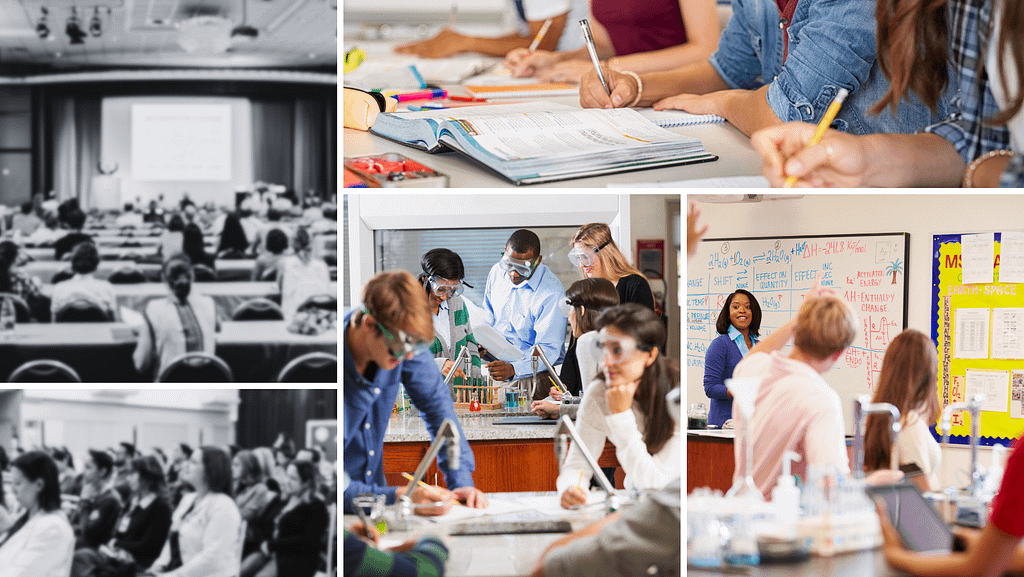
The Difference Between the Sidelines and the Front Lines
In PD, you’re observing. You’re analyzing scenarios … nodding along with best practices. You’re imagining how it might look in your classroom.
In your classroom, you are living it.
During PD:
- The examples are neat and tidy.
- The behavior scenarios resolve cleanly.
- The pacing chart makes sense.
- The lesson seems doable in 45 minutes.
In reality:
- The lab materials run out.
- The fire alarm interrupts your best explanation.
- A student shuts down mid-activity.
- Another one finishes everything in five minutes and is bored.
- Someone asks a question that derails your entire plan.
- And somehow, it’s already 3:15.
Teaching on the “front lines” is dynamic, unpredictable, and deeply human. It requires split-second decisions, demands emotional intelligence, and forces you to balance content mastery with classroom management, differentiation, and relationship-building — all at once.
That is something no PD can fully simulate.

My Rookie Year: Excited… and Completely Unprepared
In my first year teaching, I was somewhat nervous, extremely excited, and wholly unprepared.
I had earned a degree in Science. I understood chemistry. I could solve stoichiometry problems in my sleep. I knew how to analyze data, explain reaction mechanisms, and break down thermodynamics.
What I did not know was how to manage a classroom.
I had no formal education training under my belt. No student teaching experience that truly mirrored reality. No crash course in adolescent psychology. So pretty much straight out of college, I was teaching the way my college professors had taught me.
Lecture-heavy.
Content-focused.
Fast-paced.
Assuming students would “just follow along.”
Spoiler alert: they did not.
I lacked crucial classroom management skills. I didn’t yet understand pacing for teenagers or how much structure high school students need. I didn’t know how to keep energy up during a 90-minute block or how to redirect behavior without escalating it.
Needless to say, my students were struggling … and I felt terrible.
I was overwhelmed almost immediately. I remember going home thinking, “What am I doing wrong?” I had the content knowledge — wasn’t that supposed to be the hard part?
I still think about that very first senior class I taught.
Did they learn anything?
Did they despise me?
Are they wondering how I’m still teaching? LOL
In all seriousness, that first year humbled me in ways I never expected.

Walking Out Alive Is No Small Feat
There is something about surviving your first few years in the classroom that changes you.
Being in the throes of a classroom environment and walking out alive after educating teens is no small feat. It is emotionally taxing. It stretches your patience. It tests your confidence. It exposes your weaknesses.
But it also teaches you — fast.
The first few years were my true education. PD provided the foundation, but experience is what made the lessons real.
Here’s what my classroom taught me that no PD ever could.
1. Content Knowledge Is Not Enough
PD often focuses on curriculum alignment, standards, or instructional strategies. But no one really prepares you for this truth:
Students don’t learn from content alone. They learn from connection.
I had to learn that knowing chemistry wasn’t the same as knowing how to teach chemistry.
I learned:
- Teenagers need structure.
- They need clarity.
- They need repetition.
- They need energy.
- They need to feel safe asking questions.
- They need to know you care.
I shifted from “covering material” to “ensuring understanding.”
That shift changed everything.
2. Classroom Management Is About Relationships, Not Control
No PD session fully captures the emotional nuance of managing 25 personalities at once.
I learned that classroom management isn’t about being the strictest person in the room.
It’s about consistency, having clear expectations, follow-through, and relationships.
Students are far more responsive when they feel respected.
When I stopped trying to prove I was “in charge” and instead focused on building rapport, the tone of my classroom shifted.

3. Engagement Is a Skill You Develop Over Time
Early on, I thought engagement meant having flashy activities or elaborate labs.
Now I know engagement is about intentional design.
It’s about:
- Breaking lessons into digestible chunks
- Building in movement or discussion
- Checking for understanding frequently
- Making students do something with the content
I learned to watch body language.
I learned to pivot mid-lesson.
I learned that silence can mean confusion, not comprehension.
No slide deck can teach you that instinct. You develop it by reading the room — over and over again.
4. Pacing Is an Art
In PD, pacing guides look clean and logical.
In reality, pacing is responsive.
Some classes need more time.
Some topics take longer than expected.
Some days are slower because students are exhausted.
Some days fly because they’re locked in.
I learned that rushing content to stay “on track” often backfires. Depth matters more than speed.
That wisdom came from watching glazed-over eyes and thinking, “We need to slow down.” And between you and me, I’d rather cover some of the material well than most of the material poorly.

5. Flexibility Is Survival
You can have the perfect lesson planned.
And then:
- The copier breaks.
- A lab goes sideways.
- Half the class is absent.
- The technology crashes.
Experience taught me to be flexible.
In short, front-line teaching develops resilience and adaptability. You learn to adjust, simplify, regroup, and keep going.
The sort of real-time problem-solving that only being in the classroom can teach.

6. Confidence Comes From Doing, Not Watching
One of the biggest differences between PD and real teaching is this:
PD gives you ideas.
Experience gives you confidence.
The first time you successfully redirect a disruptive moment.
The first time a struggling student finally understands.
The first time a lab runs smoothly because you anticipated issues.
Those moments build belief.
And belief changes how you show up.
What Only the Classroom Can Teach
Professional development has value. It introduces us to research, tools, and best practices. It connects us to other educators. It can inspire new approaches.
But nothing replaces standing in your own classroom.
Nothing replaces learning your students.
Nothing replaces navigating real challenges.
Nothing replaces the growth that comes from trying, failing, adjusting, and trying again.
My classroom has been my greatest teacher.
It humbled me.
It stretched me.
It shaped me.
And while PD gave me frameworks, the front lines gave me wisdom.
If you’ve ever walked out of your classroom exhausted but proud — you know exactly what I mean.