
As chemistry teachers, we know math isn’t just a side skill — it’s the backbone of pretty much everything we do. From balancing redox reactions to calculating molar mass or pH, math gives chemistry its structure and precision.
So, what happens when students come into chemistry class without those math foundations? Lately, that’s becoming the norm rather than the exception — and it’s something many of us are feeling in our classrooms.
The Decline in Math Scores
It’s no secret that kids in our nation have fallen behind in math, partly due to the pandemic.
- According to the National Assessment of Educational Progress (NAEP), math scores for 12th graders in 2024 were at their lowest point since the assessment began.
- The gap between the highest and lowest-performing students in math has widened, and more students than ever are performing at the lowest levels.
- In 12th grade reading and math, as well as eighth grade science, the steepest declines were observed among the country’s lowest-performing students.
- The National Science Foundation reports these are the largest declines in over 30 years, especially impacting under-resourced schools.

These numbers aren’t just statistics — they’re real students sitting in our labs. When students lack confidence with algebra, stoichiometry feels impossible. When fractions and ratios are shaky, molarity and percent yield problems can feel like another language.
And it’s not just about grades. Struggling with math can erode confidence and curiosity. Many students start thinking, “I’m bad at math, so I’ll never be good at chemistry.” Unless we help them rebuild that confidence, those thoughts can stick.

How Chemistry Teachers Can Support Students Who Struggle with Math
We can’t reteach years of algebra — but we can help students feel more capable and confident using math in chemistry. Here are some practical ideas that make a real difference:
- Start with a quick math check-up
Early in the year, give a short diagnostic or “math refresher quiz” on algebraic manipulation, fractions, and unit conversions. Knowing where students stand helps you target support before big chemistry topics hit. - Offer simple reference sheets
Give students a “math-in-chemistry” cheat sheet that includes reminders like:
- How to rearrange equations
- Fraction rules and exponent basics
- Unit conversion steps
- Dimensional analysis templates
- How to rearrange equations
- Show every algebra step
When working through stoichiometry or gas law problems, don’t skip steps — even if a part seems simple. Write out how you isolate a variable or cancel units. What feels “obvious” to us often isn’t to them — showing your thinking models confidence. - Break math-heavy problems into smaller chunks
Try a three-stage approach:
- Stage 1: Solve the math (pure algebra).
- Stage 2: Apply it to the chemistry context.
- Stage 3: Interpret the meaning and units.
- Stage 1: Solve the math (pure algebra).
This helps students build understanding piece by piece instead of feeling overwhelmed.

- Start class with quick math warm-ups
Short 5-minute math refreshers — like rearranging formulas or canceling units — keep math skills active and connected to chemistry.
I often do this prior to each class, especially before quizzes.
- Use visuals whenever possible
Graphs, models, and diagrams make the math more tangible. For instance, showing mole ratios as particle diagrams can help students see the proportional relationships before they calculate them.
Don’t forget videos are a great way to show these kinds of abstract relationships and drive home these core concepts! - Encourage peer support
Pair students strategically so stronger math students can guide others through structured activities. - Assign small, focused practice sets
Give short “math for chemistry” practice sheets that target one skill at a time. A few minutes of focused practice can make a big difference over time.
I usually incorporate these into our daily/weekly classwork grade and plan them around quizzes and labs.
Keep connecting math back to meaning
Show students how math protects their results. A single miscalculation can throw off a lab’s entire conclusion — but getting it right helps their science make sense. When students see math as useful, not separate, motivation follows
CHEMcademy: Making Math in Chemistry Manageable
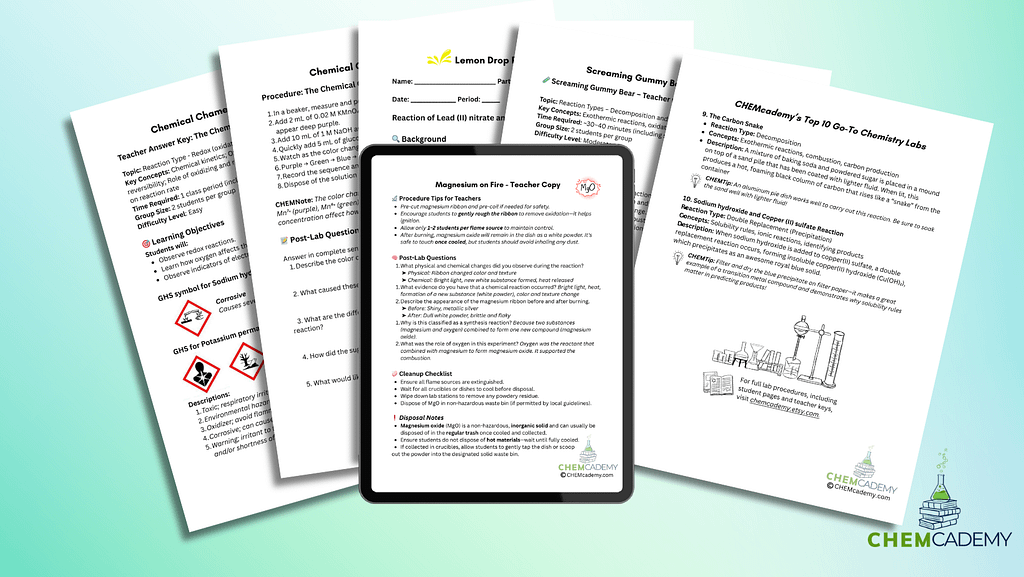
All of these challenges are exactly what CHEMcademy was built for. You don’t have to create all these supports from scratch. The resources and tips you find here come directly from me — a fellow high school chemistry teacher who has spent years navigating these same struggles, learning, refining, and growing. And I haven’t done it alone. I’m grateful to have had colleagues, friends, and professors who have poured their wisdom into me over the years. CHEMcademy is my way of passing that knowledge forward — to make teaching chemistry clearer, easier, and more enjoyable for every teacher who steps into the lab or classroom.
If you want classroom-tested, ready-to-go labs, check out the CHEMcademy Etsy shop and start building a chemistry toolkit you’ll actually use.